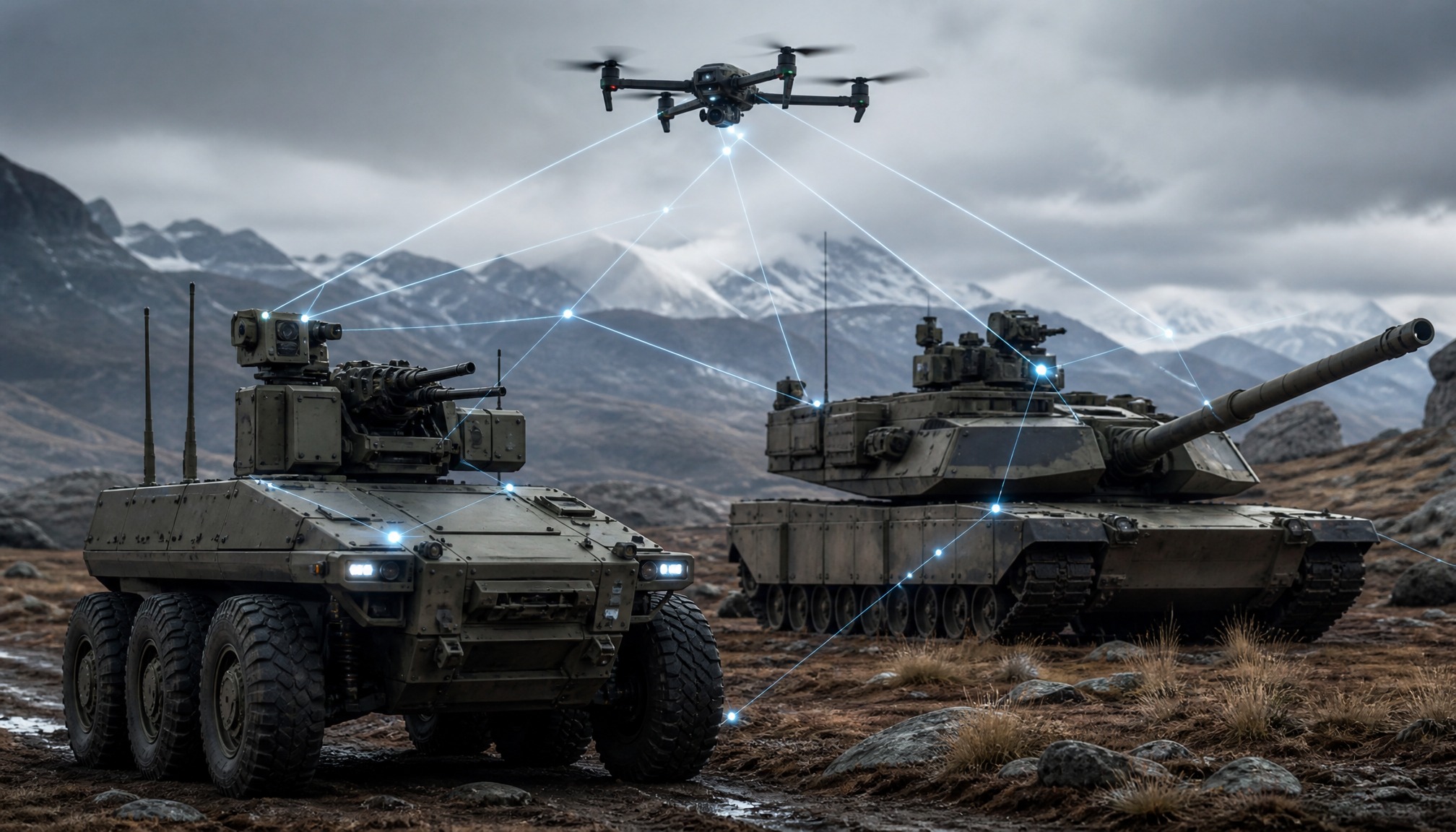
The Armoured Corps is working to integrate a Manned-Unmanned Teaming capability as part of a broader push toward networked and autonomous operations on the battlefield. The programme marks a shift in ground-based combat operations, pairing manned crews with autonomous platforms within a unified command structure.
Robotic ground units and aerial drones operate together, directed by a centralised command and control hub. The platforms carry a suite of sensor technologies — including LiDAR, thermal imaging, and electro-optical systems — enabling broad environmental awareness across varied deployment conditions. By combining these capabilities, military leaders can identify, track, and address potential threats with improved accuracy and response time.
The platform is built to accommodate loads between 500 and 1,000 kilograms. The vessel is capable of travelling between 30 and 40 kilometres per hour, with a hybrid-mode endurance of up to 12 hours. Those technical attributes allow the unmanned ground vehicle to operate across disputed or hostile environments, where sustained performance determines whether a mission achieves its objectives.
The UGV relies on self-directed navigation as one of its core operational functions. Equipped with autonomous navigation, real-time environmental mapping, collision-avoidance systems, and encrypted communications, the vehicle is capable of operating independently across challenging terrain. The technology is designed to reduce reliance on constant human monitoring while allowing the platform to absorb operational dangers that would otherwise fall to armoured vehicle crews or infantry personnel.
The vehicle's weapons configuration accommodates remote weapon stations, medium machine guns, and anti-tank guided missile systems. The platform is also capable of carrying Intelligence, Surveillance, and Reconnaissance payloads, broadening its operational role on the battlefield.
Integrating unmanned aerial vehicles and loitering munitions within a unified command structure produces both offensive and defensive layers, reflecting a contemporary military doctrine in which personnel direct operations while automated systems absorb operational risk. The methodology aligns with the operational conditions found in India. The border with China presents elevation and plateau obstacles, whereas the frontier facing Pakistan encompasses floodplain and arid terrain.
Indiscriminate fire directed at unverified positions has, throughout documented military history, resulted in fatalities before the full extent of a threat could be established. Linked ground and aerial vehicle platforms are designed to gather situational awareness ahead of operations, with the aim of lowering personnel losses and enhancing mission outcomes.
Armed forces around the world are increasingly adopting combined crewed and autonomous vehicle operations as the next phase of land warfare. The army seeks to combine automated systems with human oversight, reducing operational risk to troops while enhancing combat capability.
The focus on hybrid endurance, encrypted communications, and multi-role payloads points to a broader goal of developing a flexible platform capable of supporting a wide range of operational requirements. The move fits within a wider national push to advance homegrown capabilities and incorporate cutting-edge technology across the defence sector.
The Armoured Corps has been developing unmanned ground vehicles with heavy-lift capacity, autonomous navigation, and drone interoperability, aiming to function within a networked, multi-domain framework where tempo, protection, and communication are identified as determining factors.