Ceasefire Talks Continue Amid Mixed Messages in US-Iran Negotiations and Israel-Lebanon Agreement
Ceasefire Talks Continue Amid Mixed Messages in US-Iran Negotiations and Israel-Lebanon Agreement
Ceasefire negotiations in the Middle East continue with mixed messages from US and Iranian officials on the status of talks. Israel and Lebanon have agreed to a ceasefire, contingent on the withdrawal of Hezbollah operatives and cessation of fire. The US House of Representatives has passed a resolution to limit presidential war powers in Iran, reflecting legislative oversight of military actions.
World
Politics
World
Related Posts
Below are some popular stories that may be of interest to you.
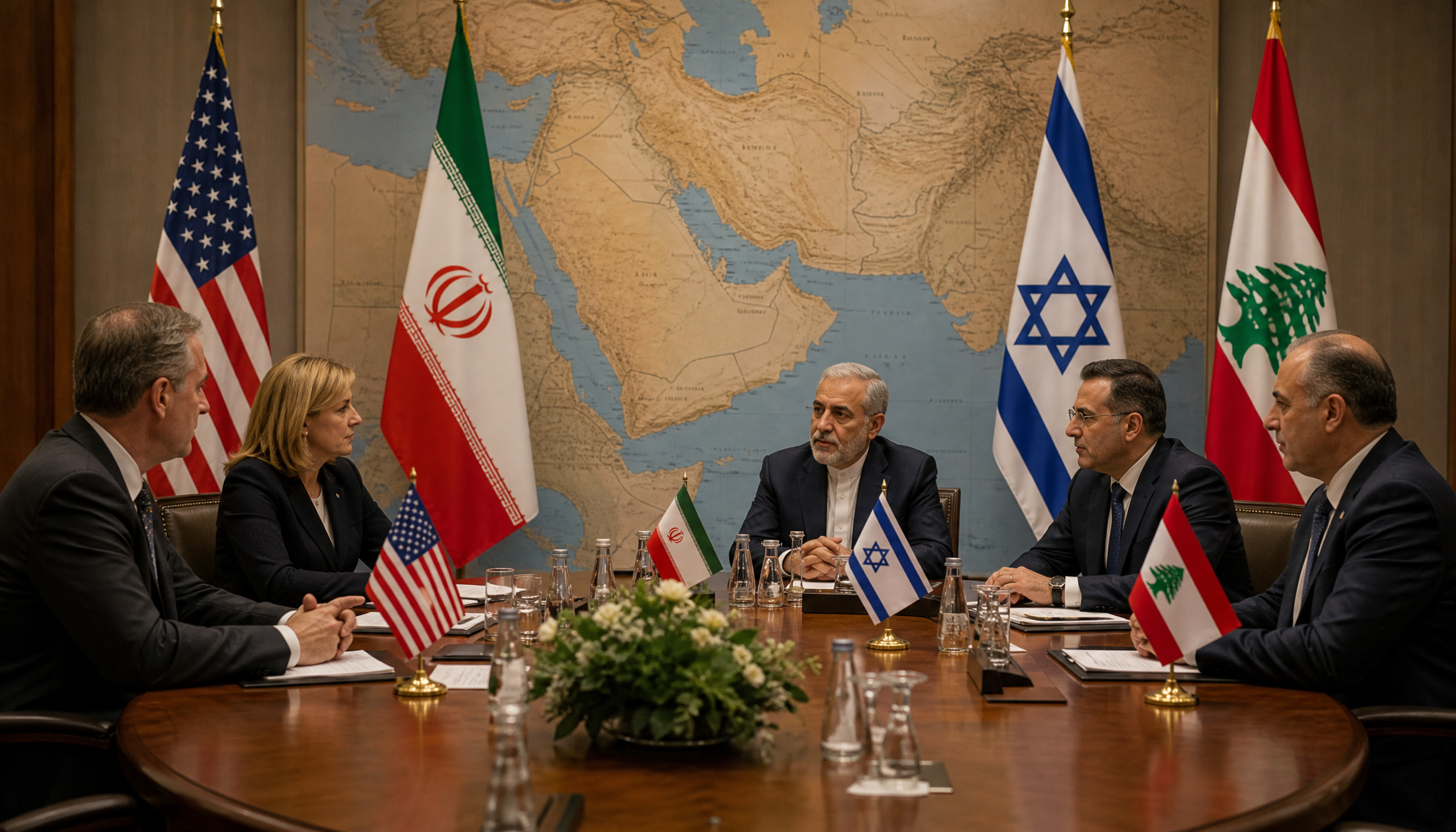
An AI-generated image: Diplomatic representatives from the US, Iran, Israel, and Lebanon discuss ceasefire terms in a high-level negotiation.
Reports on negotiations between Washington and Tehran to conclude hostilities have been inconsistent. On Wednesday, President Donald Trump characterized discussions as proceeding well, while Iran's Foreign Minister Abbas Araghchi indicated that recent days had yielded no notable progress; the House adopted a resolution Wednesday to constrain Trump's war-making authority regarding Iran, representing a notable legislative pushback on the president's approach to the dispute; following another negotiating session, Israel and Lebanon reached agreement on ceasefire implementation, conditional upon Hezbollah ending fire and withdrawing operatives from southern Lebanon; Trump described Israeli Prime Minister Benjamin Netanyahu as a valuable partner, days following a strained telephone exchange between the two leaders. A statement released on Wednesday indicated that both nations have committed to enacting a truce, provided that all hostile actions by the militant group cease and its fighters withdraw from the border region. The current state of negotiations between Washington and Tehran remains ambiguous. Regional developments include the following: President Donald Trump characterized Wednesday's negotiations with Iran as progressing favorably, while Foreign Minister Abbas Araghchi reported limited advancement in recent discussions; Araghchi stated that resolution of the US-Israel conflict with Iran requires cessation of hostilities in Lebanon and withdrawal of Israeli forces currently engaged against Hezbollah since early March; Israeli Ambassador to the US Yechiel Leiter minimized reported disagreements between Trump and Prime Minister Benjamin Netanyahu, noting that Hezbollah bears responsibility should the ceasefire collapse; and the House adopted a resolution Wednesday constraining presidential military authority in Iran, representing notable congressional pushback against Trump's approach to the conflict. This report includes contributions from Helen Regan, Camila DeChalus, Sarah Ferris, Ellis Kim, Aileen Graef, Michael Williams, Mustafa Qadri, Eyad Kourdi, Kunal Sehgal, Aida Karimi, Tim Lister, Sarah Tamimi, Mostafa Salem, Catherine Nicholls and Jennifer Hansler of CNN. A joint statement issued following US-mediated negotiations on Wednesday indicated that both nations have reached an understanding on ceasefire terms, which require Hezbollah to halt all attacks and withdraw its forces from the southern region. The agreement follows statements from Israeli officials about potentially expanding operations in Lebanon, which could complicate ongoing diplomatic discussions between Washington and Tehran. The ceasefire agreement has experienced breaches, with both parties exchanging fire across the border. The discussions on Wednesday extended for approximately nine hours, following a prior day of negotiations on Tuesday at the State Department. The joint statement indicated that both sides would reconvene political and security discussions during the week of June 22 to work toward a comprehensive agreement, with facilitation of communication between the parties to continue in the meantime; the two nations also committed to rapidly establishing pilot zones where the Lebanese Armed Forces would assume exclusive territorial control without any non-state actors present, though no specific timeline was provided; the statement noted that security and territorial integrity could only be achieved through the disarmament and dismantlement of Hezbollah's infrastructure throughout the country; support for the Lebanese Armed Forces was emphasized to enhance their capacity and enable effective sovereignty across all territory. On Wednesday, Iran's Foreign Minister Abbas Araghchi stated that discussions with the United States over recent days have yielded little advancement, contrasting with President Donald Trump's characterisation of the exchanges as proceeding positively, while noting that Tehran communicated this week regarding the necessity of averting an Israeli strike on Beirut. On Wednesday, Trump described negotiations to end the war in optimistic terms, indicating that progress might occur by the weekend. On Wednesday, the House approved a measure to constrain the president's military authority regarding Iran, delivering a notable legislative rejection of the administration's approach to the situation. Democratic lawmakers have initiated multiple congressional votes in both chambers seeking to constrain presidential authority over military action, with increasing bipartisan backing in recent periods. The tally stood at 215 to 208, with members of the Republican Party among those voting. Representatives Thomas Massie, Brian Fitzpatrick, Tom Barrett and Warren Davidson voted with the opposing party in favour of the measure. The vote, scheduled for May 21, was postponed by Republican leadership when it became clear the measure would not pass owing to member absences. Abbas Araghchi, serving as Foreign Minister, indicated that military forces stand prepared to act if hostilities resume in Beirut, stating that personnel remain on standby to fulfil their responsibilities should Israeli operations target the city's southern areas following any breakdown in the truce. The remarks were delivered on a day when discussions facilitated by Washington between Israel and Lebanon occurred, and airstrikes in Lebanon's south resulted in eight fatalities, as reported by health authorities there. Following almost nine hours of talks, both nations reached an accord that requires Hezbollah to halt attacks and withdraw its forces from the southern region of Lebanon.
Ukraine has agreed to a U.S.-proposed 30-day ceasefire deal, pending Russia's response. The proposal includes the resumption of U.S. military aid to Ukraine. Key issues such as NATO membership and territorial disputes remain unresolved.